Is Poker Luck or Skill? What the Data Says
It’s the first question everyone asks about poker, and it almost always comes with an answer already decided: “that’s just luck.” The honest version is more uncomfortable. Poker is luck and skill at once, but each one rules on a different timescale. Understanding where one ends and the other begins is probably the most useful thing you can learn before your next session.
In the short run, luck rules (and that’s a good thing)
In a single hand, or a single night, anyone can beat anyone. That isn’t a nice phrase, it’s math. When you get all the chips in with a pair of aces against a pair of kings, you win 82% of the time. Put another way: you lose that hand, with the best possible spot before the flop, one time in five and a half. A normal flip (two high cards against a medium pair) you lose almost half the time.
Now string a few of those spots together over a night. It’s perfectly possible to play every hand better than your opponent and still walk away down. That’s why poker is a living game and not a chess tournament where the best player always wins: short-run variance keeps the weaker player alive and eager to come back. If the best player won every night, nobody else would sit down.
In the long run, skill converts
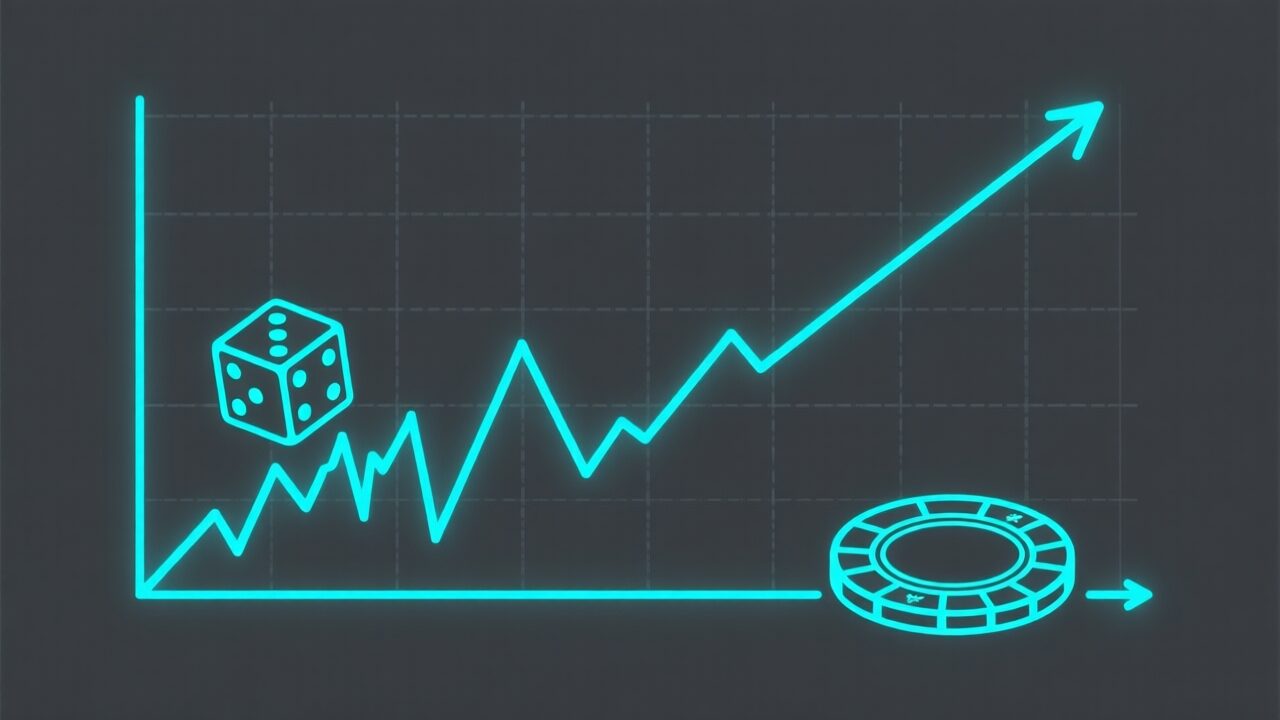
The trick is the word “long.” Variance doesn’t disappear, it averages out. The more hands you play, the closer your result drifts to your real level, the same way a coin weighted to 55% looks fair over ten flips and gives itself away over ten thousand.
The numbers of professional players show it clearly. A strong regular’s edge is measured in tiny units: a few big blinds per 100 hands. With an edge that thin, they can still have losing weeks across twenty or thirty thousand hands. And yet look who reaches the final tables of the same series year after year. Those aren’t random names. If poker were only luck, the winners would rotate like a lottery, and they don’t.
There’s one figure that sums up why. An analysis of online hands from 2009 (the Cigital study) found that nearly 76% of hands are decided without anyone showing their cards: someone bets, the rest fold, and the cards never matter. If three out of four pots are won by how you bet and not by what you’re dealt, do you really think the card is what decides?
What “skill” actually means here
When we say poker rewards skill, we don’t mean guessing cards. We mean a handful of concrete things, and every one of them can be trained:
- Estimating your equity and comparing it against what it costs to stay in the hand. It’s the central math decision, and you can drill it on its own with the equity calculator.
- Thinking in ranges instead of one specific opponent hand.
- Using position, bet sizing, and the information each street reveals.
- Keeping your head when variance hits, which is where most players give back the money they earned by playing well.
None of those skills has anything to do with luck. All of them can be measured, corrected and improved with repetition. That’s why poker looks more like chess with dice than roulette: the dice add noise, but the decisions decide the outcome once enough hands go by.
What this means for you
Two practical conclusions come out of this, and they pull in opposite directions depending on the timescale.
In the short run, accept the luck. You’ll lose hands you played perfectly and win a few you played terribly. Measuring your night by the result is the mistake that busts you fastest: a good decision that turns out badly is still a good decision. That discipline, separating the quality of the play from the whim of the card, is half the game.
In the long run, trust the skill and work on it. The edge is real, but so thin that it only shows up if you play a lot and decide well consistently. The cheap way to stack up those reps without exposing yourself to money variance is to practice real spots, scored against the correct play, in your training, and to test lines against bots in the table simulator. There, luck can’t take away what you learned, because there’s nothing to lose but points.