Card values in poker (and where the suits and face cards come from)
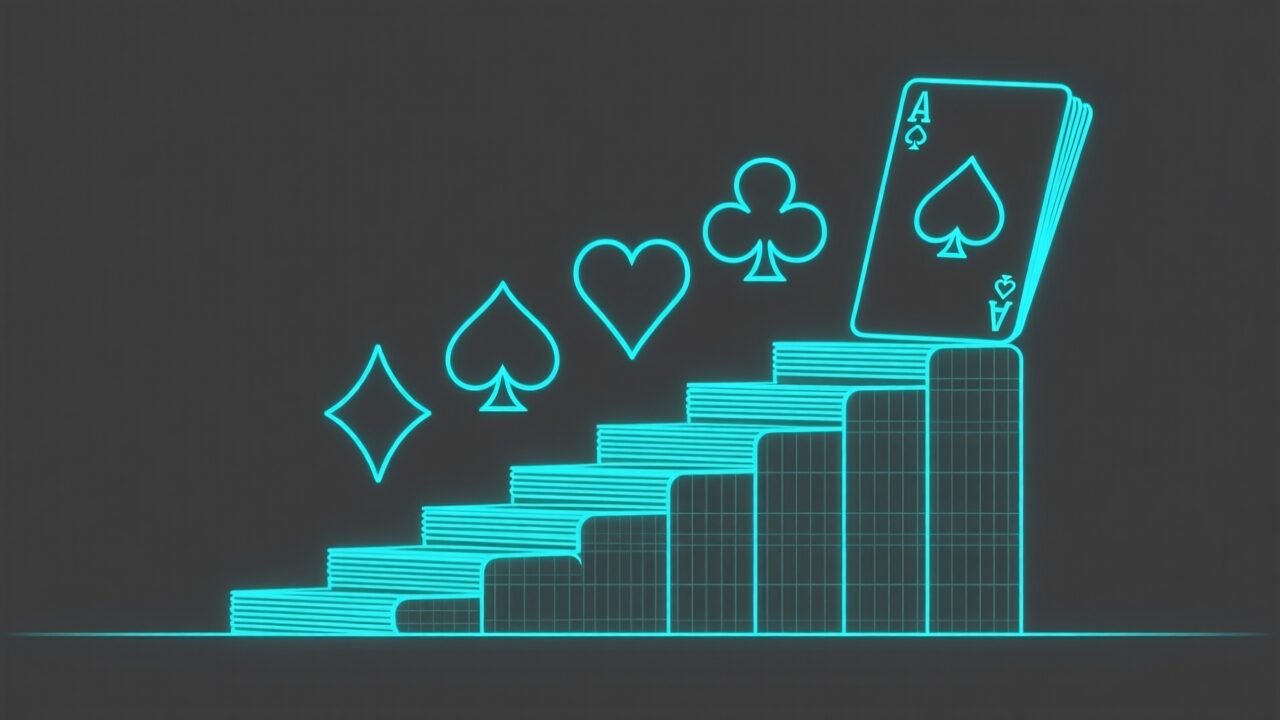
There’s a mistake that shows up in almost every first game: someone makes a pair of aces, looks at the table and asks whether that’s worth anything. The doubt comes from how we learned to count cards. We recite “ace, two, three, four…” with the ace opening the line, and if it goes first it looks like the small one.
In poker it’s the other way round. The ace is the highest card in the deck.
The order, top to bottom
These are the 13 ranks, from the one that wins to the one that loses:
Ace, K, Q, J, 10, 9, 8, 7, 6, 5, 4, 3 and 2.
That’s all. No special cards, no hidden values: the two is the weakest of the 52 and the ace the strongest, which is why the best starting hand in Hold’em is a pair of aces, dealt to you once every 221 hands.
If you want the next step up, how those cards combine into pairs, flushes and straights, it’s in the hand rankings from best to worst.
The ace also plays low
Here’s where the rule gets a wrinkle, and it’s worth knowing before it costs you a pot. The ace counts as the highest card, but it can also act as a 1 to form the lowest straight: A-2-3-4-5, known at the tables as “the wheel”.
What it can’t do is play through the middle. Q-K-A-2-3 is not a straight, it’s nothing. The ace works at both ends of the line, never as a bridge between them. It’s one of the details that gives away the most pots among beginners, and it’s explained with examples in the hand ranking lesson of the course.
No suit outranks another
Second idea, and this one has no wrinkles: in poker all four suits are worth the same. The 13 spades are worth exactly what the 13 hearts are worth, and a spade flush doesn’t beat a heart flush. When two players make the same hand you compare ranks one by one, and if they all match the pot is split. No suit breaks the tie.
The exception has nothing to do with hand strength; it’s table bookkeeping. When something has to be decided at random and there’s no other way, the bridge order is used: spades, hearts, diamonds, clubs. That’s how the odd chip of a split pot gets assigned, or who opens in stud. Never to decide who wins.
Where the suits came from
The four symbols you use today are French, from around 1480. Before that, German decks used hearts, bells, acorns and leaves, drawings with too much detail to print quickly. The French reduced them to flat silhouettes that could be stencilled with two inks. The spade comes from the German leaf and the club from the acorn, and they won for the reason things usually win: they were cheaper to make.
You’ve probably heard that the suits stand for the social classes, hearts for the clergy and spades for the nobility. It’s a nice reading with no documentary support, added centuries later. The suits are shapes that were easy to print.
Who the king, queen and jack are
This part is documented. The Parisian printers of the 17th century settled on a convention and gave a name to each of the 12 face cards, one per card, and those names were printed on the deck:
| Suit | King | Queen | Jack |
|---|---|---|---|
| Spades | David | Pallas | Ogier |
| Hearts | Charlemagne | Judith | La Hire |
| Diamonds | Caesar | Rachel | Hector |
| Clubs | Alexander | Argine | Lancelot |
They mix the Bible, antiquity and French legend with no particular plan, which is a sign they were chosen for prestige rather than meaning. The convention was lost outside France, but the drawings stayed, and with them two oddities people still notice.
The king of hearts appears to be driving his sword into his own head, which is why he’s called “the suicide king”. The most accepted explanation is a boring one: in the old designs he held an axe, and after centuries of copying plate from plate the handle wore away until only a blade crossing his hair was left. The other oddity is the one-eyed cards. The jacks of spades and hearts and the king of diamonds are drawn in profile, so they show a single eye, and there’s no mystery behind it: the pose came with the original pattern.
Our own cards keep those traditional court figures, suicide king included, badly-copied sword and all.
What the deck doesn’t mean
For decades the story has circulated that the deck is a hidden calendar: 52 cards for the 52 weeks, 4 suits for the seasons, 13 ranks for the lunar cycles and 12 face cards for the months. And yes, if you add up all the values from ace to king you get 91 per suit, 364 in total, one day short of a year.
The arithmetic is right and the conclusion is wrong. The numbers come out because 52 is 4 times 13, not because anyone encoded anything. Any deck with those divisions would give the same result. It’s the same kind of coincidence that makes a year run almost exactly 52 weeks.
The joker usually gets dragged into the story as “day 365”. Also no: it joined the deck much later and for a different reason, and poker doesn’t even use it, as we cover in the joker entry.
One deck, many games
The 52 cards go well beyond poker. With them you play bridge, blackjack, gin rummy, rummy and solitaire, all designed for this deck.
And there’s a group worth separating, because the internet lists them together and they don’t belong together. Tute, brisca, cinquillo, escoba, pocha and chinchón are Spanish-deck games, built for 40 cards. You can play them with the English deck, but you have to adapt it: remove the 8s, 9s and 10s and you’re left with exactly 40 cards, with the jack, queen and king standing in for the sota, caballo and rey.
If you feel like putting the deck to work right now, there’s the free solitaire with these same cards: it deals 28 into seven columns, leaves 24 in the stock and asks for no sign-up. It’s the fastest way to end up staring at the deck long enough to never again wonder whether the ace is in charge.
And if you want card values to actually count for something, try poker solitaire: 25 cards come out one at a time and you place them on a 5×5 grid, and at the end the hands your rows and columns made are scored. Knowing the order isn’t enough there — you have to decide which square each card is worth most in before you see the next one.